

Want to work as a nail technician in Florida?
In Florida, the license commonly called a “nail tech license” is officially known as a Nail Specialist Registration.
To qualify, you must complete a Florida-approved nail specialty program, submit your application through the Florida Department of Business and Professional Regulation, and complete the required HIV/AIDS course. The good news: Florida does not require a state board exam for Nail Specialist registration.
This guide explains the 2026 requirements, training hours, cost, application process, renewal rules, endorsement options, and what you can legally do once licensed.
- Exam Requirements & Process
- Hours, Costs & Timeline
- Exam & Online Options
- Transfer to Florida (Reciprocity/Endorsement)
- Renewal & Continuing Education
- Legal & Business (At-home, Penalties, Salon Setup)
- Careers & Earnings
Florida Nail Technician License Requirements at a Glance
Before we break down each step, here’s a quick look at the main Florida Nail Specialist license requirements you need to know.
| Requirement | Florida Nail Specialist Rule |
| Official license name | Nail Specialist Registration |
| Licensing agency | Florida DBPR/Board of Cosmetology |
| Minimum age | 16 years old or a high school diploma |
| Training hours | 180 hours in a Florida nail specialty program |
| HIV/AIDS course | Required initial HIV/AIDS course |
| State exam | Not required |
| Application | Nail Specialist Registration, COSMO 1 |
| Renewal | Every two years |
| Continuing education | 10 hours before renewal |
What Is a Florida Nail Specialist Registration?
In Florida, the license commonly called a “nail technician license” is officially known as a Nail Specialist Registration. This registration is issued by the Florida Department of Business and Professional Regulation (DBPR) through the Florida Board of Cosmetology.
With a Florida Nail Specialist Registration, you can legally provide approved nail care services, including manicures, pedicures, nail polishing, nail extensions, and other related nail services within the scope allowed by Florida cosmetology rules.
FAQs On Nail Technician License in Florida
Exam Requirements & Process
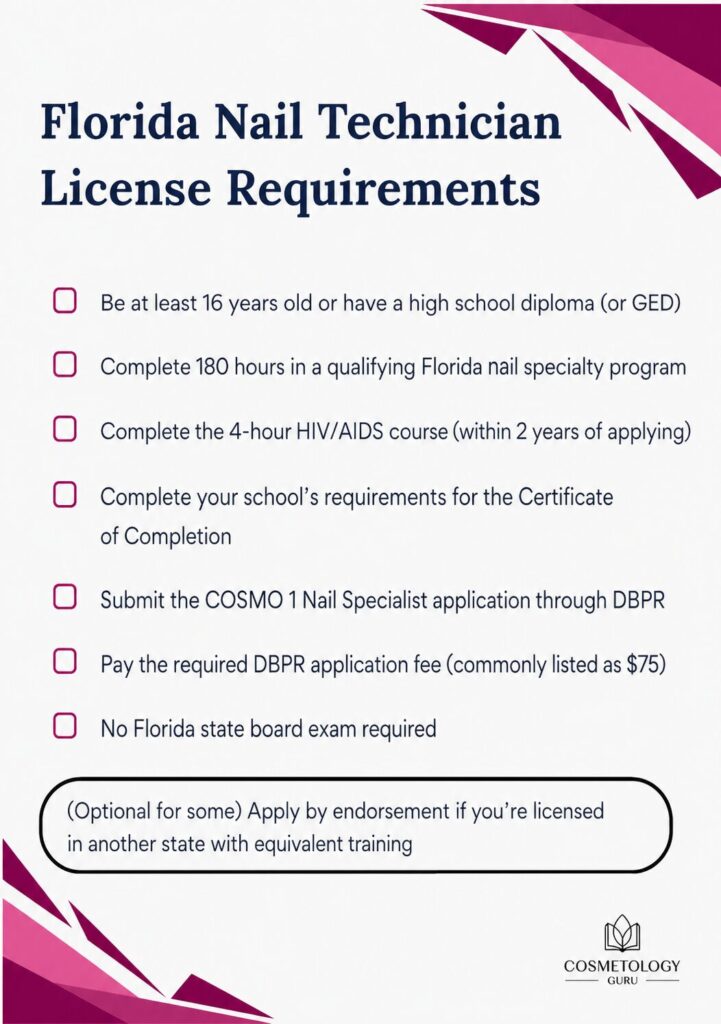
To become a licensed nail technician in Florida, you must apply for a Nail Specialist Registration through DBPR. The basic process is simple: complete the required nail specialty education, finish the HIV/AIDS course, submit your COSMO 1 application, and pay the required fee. Florida does not require a state board exam for Nail Specialist registration.
Not always. Florida requires applicants to be at least 16 years old or have a high school diploma. However, individual schools may have their own admission rules, such as requiring a diploma, GED, parent consent, or a minimum grade level.
You can apply for a Florida Nail Specialist Registration if you are at least 16 years old or have a high school diploma. If you are under 16 and do not have a high school diploma, you are not eligible to apply yet.
You can apply for your Florida Nail Specialist Registration through the Florida Department of Business and Professional Regulation, also known as DBPR. Most applicants apply online through MyFloridaLicense.com, but you may also use the printable COSMO 1 application form if you prefer to apply by mail.
Hours, Costs & Timeline
Florida requires 180 educational hours in a Florida nail specialty program to qualify for Nail Specialist Registration.
Some schools may offer longer programs, such as 240-hour options, but the state minimum for Nail Specialist Registration is 180 hours.
| Also read: States like Colorado require not just hours but passing exams, too. |
The DBPR application fee for a Florida Nail Specialist Registration is commonly listed as $75 for applicants applying based on Florida education. However, your total cost will usually be higher because you also need to pay for nail school tuition, supplies, and possibly the required HIV/AIDS course if it is not included in your program.
Most students can complete the Florida nail specialist licensing process in about 2 to 4 months, depending on the school schedule and how quickly the application is processed.
Full-time nail specialty programs may be completed faster, while part-time, evening, or weekend programs can take longer. After you finish your required 180 training hours and complete the HIV/AIDS course, you’ll still need to submit your application to DBPR and wait for approval.
Exam & Online Options
No. Florida does not require a state board exam for Nail Specialist Registration.
Instead, applicants must complete the required nail specialty education, finish the initial HIV/AIDS course, submit the required documents, and apply through DBPR.
Your school may require internal written or practical assessments before issuing your Certificate of Completion, but Florida does not require a separate state licensing exam for this registration.
You cannot get a Florida nail tech license entirely online. The DBPR application and the required initial HIV/AIDS course may be completed online, but your nail specialty education must be completed through a qualifying Florida nail specialty program.
Some schools may offer blended learning, such as online theory classes with in-person practical training. However, before enrolling, confirm that the program meets Florida’s Nail Specialist Registration requirements.
Transfer & Reciprocity
Florida does not simply “transfer” a nail license automatically. If you are licensed in another state, you may apply for Florida Nail Specialist Registration by Endorsement.
To qualify, you generally need an active out-of-state nail specialist, manicurist, pedicurist, or equivalent license and proof that your training meets Florida’s requirements. DBPR’s endorsement form states that Nail Specialist endorsement applicants must have completed at least 180 hours of training before being registered as a specialist.
Florida won’t make you sit for a state exam, but a quick practice test is a great way to check how much you’ve learned.
Nail Technician Free Practice Test
What to Do After Getting Your Florida Nail Technician License
After receiving your license, it’s about keeping your license active, knowing the rules, and shaping the kind of career you want.
Here are answers to the common “what’s next?” questions that often pop up right after licensure.
Renewal & Continuing Education
Florida Nail Specialist registrations must be renewed every two years. To keep your registration active, you need to renew through DBPR and complete the required continuing education before your renewal deadline.
DBPR states that cosmetologists, nail specialists, facial specialists, and full specialists must complete 10 hours of board-approved continuing education before renewing an active or delinquent-active license or registration.
Renewal deadlines are tied to your assigned license group, and DBPR usually sends renewal notices before the expiration period. To avoid missing important updates, keep your email address and contact information current in your DBPR account.
Legal & Business
Yes. You must hold the proper Nail Specialist Registration to perform nail services for compensation in Florida. In addition, services generally must be performed in a properly licensed salon setting.
A home-based nail salon may be possible, but the location must meet Florida salon licensing and inspection requirements. You should not assume that having a Nail Specialist Registration alone allows you to provide paid nail services from any home location.
To open a nail salon in Florida, you generally need a DBPR cosmetology salon license in addition to any personal professional registration required for the services being performed. The salon must meet applicable sanitation, facility, safety, and inspection requirements.
If you plan to hire or rent booths to other nail specialists, make sure each service provider has the proper active registration or license.
Retail sales and non-contact demonstrations do not require a license in Florida. Any nail, hair, or skin service performed on clients for compensation does.
Practicing nail services without the required Florida registration can lead to legal and administrative consequences. Florida law prohibits practicing cosmetology or a specialty without an active license or registration, operating an unlicensed salon, or allowing unlicensed people to perform regulated services. Violations under Florida’s cosmetology statute can be treated as second-degree misdemeanors.
Because penalties and administrative fines can vary by violation, always check current DBPR and Florida Board of Cosmetology rules before offering paid services.
Career & Earnings
With a Florida Nail Specialist Registration, you may work in settings such as nail salons, spas, resorts, hotels, and beauty businesses that offer nail services. Some professionals also move into booth rental, salon ownership, education, product sales, or brand work.
If you want to offer mobile or home-based nail services, check the DBPR salon licensing rules first. Your personal registration does not automatically allow you to perform paid nail services anywhere.
Nail technician income in Florida varies by city, salon type, schedule, experience, tips, commission structure, and whether you are an employee, booth renter, or salon owner. Entry-level nail specialists may earn less while building a client base, while experienced nail techs in busy areas may earn more through repeat clients, add-on services, and tips.
For SEO and usefulness, include city-level examples such as Miami, Orlando, Tampa, Jacksonville, Fort Lauderdale, and Naples.
Start Your Nail Career in Florida
Now you know what it takes and how to get a nail license in Florida.
From completing your training hours to applying with DBPR, the steps are simple, clear, and totally doable.
If this is the career you’ve been thinking about, there’s really just one thing left: start your training and take the next step toward earning the license you came here to learn about.
Related Reads
Nail License Exam 2026: Key Updates And Preparation Guide
9 Best Nail Salon Designs In 2026: A Comprehensive Guide
California Nail Technician State Board Exam: Practice Test And Essential Information