
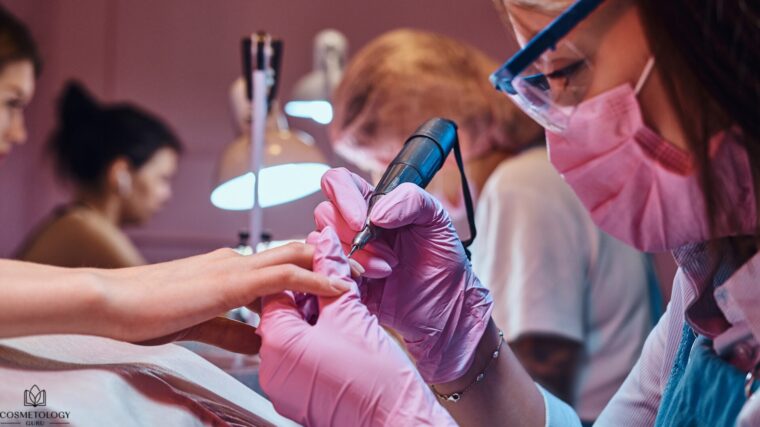
Learn how to recognize common nail disorders, distinguish noninfectious nail changes from possible infections, identify contraindications, and make safe service decisions for the cosmetology licensing exam and professional salon work.
Quick Answer
A cosmetologist must examine the client’s nails and surrounding skin before beginning a manicure, pedicure, or nail-enhancement service.
You are not responsible for diagnosing a medical condition. You are responsible for recognizing visible abnormalities, determining whether the planned service may be unsafe, following your state’s rules, and referring the client to a healthcare professional when needed.
The most important nail conditions for cosmetology students to recognize include:
- Onychorrhexis
- Onychauxis
- Leukonychia
- Beau’s lines
- Onychophagy
- Hangnails
- Onycholysis
- Paronychia
- Tinea unguium or onychomycosis
- Green nail discoloration
- Nail psoriasis
- Ingrown nails
Nail assessment is directly relevant to the NIC Cosmetology Theory Examination, which tests nail anatomy, signs and symptoms of nail conditions, client evaluation, and contraindications to service.
Why Nail Assessment Matters
A nail service should never begin with automatic filing, soaking, or product application.
First, examine:
- The nail plate
- Nail color
- Nail thickness
- Nail attachment
- Surrounding skin
- Cuticle area
- Nail folds
- Signs of swelling, pain, drainage, or injury
This assessment helps you determine whether the nail appears healthy, whether the service needs to be modified, or whether it should be postponed.
Some nail changes are harmless and noncontagious. Others may indicate infection, injury, inflammation, or an underlying medical condition. Different problems can also look similar, which is why cosmetologists recognize abnormalities but do not diagnose their causes.
Nail Disorder vs. Nail Disease
Cosmetology textbooks often separate nail conditions into disorders and diseases, but real nail conditions do not always fit neatly into one category.
For exam and salon decision-making, use this practical distinction:
Noninfectious Nail Disorder
A visible change that may result from:
- Trauma
- Habit
- Aging
- Product damage
- Temporary interruption of nail growth
- An underlying noncontagious condition
A noninfectious disorder does not automatically prohibit every service. You must still consider pain, broken skin, inflammation, nail stability, and your state’s regulations.
Suspected Nail Infection or Disease
A condition that may involve:
- Fungi
- Bacteria
- Significant inflammation
- Drainage
- Open lesions
- Spreading discoloration
- Painful swelling
Do not attempt to identify the organism or prescribe treatment. Postpone the service when required and recommend evaluation by a qualified healthcare professional.
What Healthy Nails Usually Look Like
A healthy natural nail is generally:
- Smooth
- Firm but flexible
- Attached to the nail bed
- Consistent in color
- Free from significant swelling or inflammation
- Surrounded by intact skin
Minor variations are common. A visible change does not always mean that the client has an infection.
The safest professional response depends on the entire presentation—not one isolated feature.
Onychorrhexis: Brittle or Split Nails
Onychorrhexis refers to brittle nails that may develop vertical ridges or split along their length.
The nail plate may appear:
- Dry
- Fragile
- Ridged
- Easily cracked
- Split at the free edge
Possible contributing factors include repeated wetting and drying, chemical exposure, aging, trauma, or certain health conditions.
Service Decision
A gentle cosmetic service may be possible when:
- The surrounding skin is intact.
- There is no pain or inflammation.
- There are no signs suggesting infection.
- The nail is stable enough to work on safely.
Avoid aggressive filing, excessive buffing, and techniques that place additional pressure on the weakened nail.
Exam Trap
Brittle vertical splitting is not automatically a contagious condition.
Onychauxis: Thickened Nail Plate
Onychauxis is an abnormal thickening of the nail plate.
The nail may appear:
- Thicker than normal
- Harder to trim
- Less flexible
- Difficult to file
Thickening may be associated with repeated trauma, aging, pressure, or another nail condition. Fungal infections can also cause nail thickening, so a cosmetologist should not assume that every thick nail is harmless. Fungal nail infections commonly cause discoloration, thickening, and increased cracking or breakage.
Service Decision
Do not aggressively reduce a thickened nail without first assessing:
- Color
- Odor
- Nail attachment
- Surrounding skin
- Pain
- Crumbling or debris
- Other signs of possible infection
When the cause is uncertain or infection is suspected, postpone the service and recommend medical evaluation.
Exam Trap
Onychauxis means nail thickening. It does not tell you the cause.
Leukonychia: White Spots or White Areas
Leukonychia refers to white discoloration of the nail.
Small white spots are often associated with minor injury to the nail matrix and generally grow outward with the nail plate.
Leukonychia is commonly misunderstood. White spots are not automatically evidence of a vitamin deficiency or fungal infection.
More extensive whitening can have other causes and may need professional evaluation, especially if it affects several nails or is accompanied by additional changes.
Service Decision
An isolated white spot without pain, inflammation, nail separation, or other concerning changes does not usually indicate a contagious condition.
Exam Trap
Do not diagnose the cause of white discoloration based only on appearance.
Beau’s Lines: Horizontal Depressions
Beau’s lines are horizontal grooves or depressions that cross the nail plate.
They develop when nail growth temporarily slows or stops. Possible causes include illness, infection, trauma, or certain medical treatments. As nail growth resumes, the depression moves toward the free edge.
How to Recognize Them
Beau’s lines:
- Run across the nail horizontally.
- May affect one or several nails.
- Feel like grooves in the nail plate.
- Grow forward as the nail grows.
Service Decision
The groove itself is not contagious. However, the client should seek medical advice when:
- Several nails are affected.
- The lines are deep or recurring.
- There are other unexplained nail or health changes.
Avoid excessive filing that could further thin the depressed area.
Exam Trap
Beau’s lines run horizontally. Onychorrhexis commonly involves vertical ridging or splitting.
Onychophagy: Bitten Nails
Onychophagy is the habit of biting the nails.
Signs may include:
- Very short, uneven nail plates
- Damaged cuticles
- Red or irritated surrounding skin
- Small tears
- Increased risk of infection
Service Decision
A service may need to be modified or postponed if the client has:
- Open skin
- Bleeding
- Swelling
- Pain
- Signs of infection
Never apply product directly over broken or inflamed tissue.
Exam Trap
The habit itself is not contagious, but damaged skin can create a pathway for infection.
Hangnails
A hangnail is a small split or torn piece of living skin near the nail.
It is not a piece of the nail plate.
Hangnails may result from:
- Dry skin
- Picking
- Biting
- Cutting the surrounding skin
- Repeated exposure to water or irritating products
Safe Response
Do not pull or tear the loose skin.
If the area is intact and not inflamed, it may be carefully managed within the scope allowed by local regulations. If there is bleeding, swelling, pain, or possible infection, postpone the service.
The cuticle and surrounding skin help form a barrier against infection. The CDC advises against cutting cuticles because damaging this protective barrier can increase infection risk.
Exam Trap
A hangnail involves living skin, not the free edge of the nail plate.
Onycholysis: Nail Plate Separation
Onycholysis occurs when part of the nail plate separates from the nail bed.
The separated area often appears white because air is present underneath the plate.
Possible causes include:
- Trauma
- Aggressive manicuring
- Product irritation
- Psoriasis
- Fungal infection
- Other medical conditions
The American Academy of Dermatology notes that nail lifting can be associated with fungal infection, psoriasis, or manicure-related injury.
Service Decision
Do not:
- Force the separated nail back down.
- Insert tools beneath the lifted area.
- aggressively clean under the nail.
- Cover unexplained separation with an enhancement.
Moisture and debris can become trapped beneath a separated plate. The client should be referred for evaluation when the separation is unexplained, spreading, painful, discolored, or accompanied by other changes.
Exam Trap
Onycholysis is separation of the nail plate from the nail bed. It is a condition—not a diagnosis of its cause.
Paronychia: Inflammation Around the Nail
Paronychia affects the tissue surrounding the nail.
Possible signs include:
- Redness
- Swelling
- Tenderness
- Pain
- Warmth
- Pus or drainage
Paronychia can involve infection and should not be treated as a routine cosmetic problem. The AAD identifies redness and swelling around a nail as possible signs of infection.
Service Decision
Do not perform a manicure, pedicure, or enhancement service over an inflamed or infected-looking nail fold.
Avoid:
- Soaking the area
- Cutting the tissue
- Applying enhancements
- Attempting to drain the area
- Recommending medication
Politely postpone the service and advise the client to seek healthcare evaluation.
Exam Trap
When a question describes red, painful, swollen tissue around the nail, the safest answer is generally to stop or postpone the service—not to cover or cosmetically correct the area.
Tinea Unguium and Onychomycosis: Fungal Nail Infection
Tinea unguium is a fungal infection of the nail and is commonly referred to as onychomycosis.
Possible signs include:
- Thickening
- Discoloration
- Brittleness
- Crumbling
- Distortion
- Debris beneath the nail
- Separation from the nail bed
Fungal nail infections can affect fingernails or toenails, though toenail infections are more common. They may cause nails to change color, thicken, and break easily. Fungal infections can spread through direct contact and contaminated objects or surfaces.
Service Decision
When a fungal infection is suspected:
- Do not perform the service.
- Do not file the affected nail.
- Do not apply polish or enhancements to hide it.
- Do not reuse any item that may have contacted the area.
- Follow your state board and salon infection-control procedures.
- Recommend medical evaluation.
Exam Trap
Ringworm is caused by fungi, not worms. A fungal nail infection is not something a cosmetologist treats.
Green Nail Discoloration
A green, blue-green, or green-black discoloration can be associated with bacterial growth, including Pseudomonas, particularly when moisture becomes trapped beneath a lifted nail or artificial enhancement.
The AAD notes that bacterial nail infection can produce greenish-black discoloration.
Service Decision
Do not simply:
- Buff away the color.
- Reapply an enhancement.
- Seal the discoloration beneath product.
- Assume the stain is harmless.
Remove product only when this can be done safely and within your professional scope. Then stop the cosmetic service and recommend healthcare evaluation.
Common Misconception
The green color is not necessarily mold.
It may be associated with bacterial growth, but only a healthcare professional can diagnose the cause.
Exam Trap
Do not cover unexplained green discoloration with new product.
Nail Psoriasis
Nail psoriasis is a noncontagious inflammatory condition.
Possible signs include:
- Small pits in the nail plate
- Roughness
- Crumbling
- Thickening beneath the nail
- Discoloration
- Nail separation
Nail pitting can be associated with psoriasis, eczema, or alopecia areata, so appearance alone is not enough for diagnosis.
Service Decision
Psoriasis is not contagious, but that does not mean every service is automatically appropriate.
Consider:
- Whether the skin is cracked or bleeding
- Whether the client has pain
- Whether the nail is lifting
- Whether the planned product could irritate the area
- Whether a healthcare provider has given the client instructions
Use gentle techniques and avoid working over open or severely inflamed tissue.
Exam Trap
Psoriasis is not contagious. However, broken skin or severe inflammation may still contraindicate a service.
Ingrown Nails
An ingrown nail occurs when the edge of the nail presses into or penetrates the surrounding skin.
It most commonly affects the toenails.
Possible signs include:
- Tenderness
- Redness
- Swelling
- Pain along the nail edge
- Possible drainage if infection develops
Service Decision
A cosmetologist should not dig into the nail groove or attempt a medical correction.
If the area is painful, swollen, broken, or draining, postpone the pedicure and recommend professional medical care.
Exam Trap
Do not use a sharp implement to remove an embedded nail corner.
Bruised Nails
A bruised nail may develop after trauma causes bleeding beneath the nail plate.
It can appear:
- Red
- Purple
- Brown
- Darkened beneath the nail
Service Decision
Ask about recent injury and assess for:
- Significant pain
- Swelling
- Nail lifting
- Open skin
- Extensive discoloration
Do not apply pressure or enhancements to a painful, unstable, or recently injured nail. Unexplained dark discoloration should be medically evaluated rather than concealed with polish.
Splinter Hemorrhages
Splinter hemorrhages appear as thin red, brown, or dark lines beneath the nail.
They can result from minor trauma, but they may also occur for medical reasons.
Cosmetologists should not diagnose the cause.
Service Decision
A single line following a known minor injury may not indicate infection. Multiple unexplained lines, recurring changes, pain, or other symptoms justify referral to a healthcare professional.
Nail Pitting
Nail pitting appears as small depressions in the nail surface.
It may be associated with:
- Psoriasis
- Atopic dermatitis
- Alopecia areata
- Other conditions
Because several medical conditions can cause similar pitting, a cosmetologist should record the observation without naming a diagnosis.
When Can a Nail Service Proceed?
A service may be possible when:
- The condition appears noninfectious.
- The surrounding skin is intact.
- There is no unexplained pain.
- There is no active bleeding or drainage.
- There is no significant swelling or inflammation.
- The procedure will not worsen the condition.
- The service complies with state regulations and salon policy.
Even when the service may proceed, modify it to protect the client.
Examples include:
- Using less pressure
- Avoiding aggressive buffing
- Avoiding damaged areas
- Shortening the service
- Choosing a gentler product
- Documenting the observed condition
When Should a Nail Service Be Postponed?
Postpone the service when you observe signs such as:
- Suspected fungal infection
- Painful redness or swelling
- Pus or drainage
- Open or bleeding skin
- Unexplained green discoloration
- Severe nail separation
- Painful ingrown nail
- Significant recent trauma
- A condition the planned service may worsen
- Any contraindication identified by state rules
The NIC examination specifically expects candidates to evaluate the client’s nails and recognize conditions that would prohibit service.
A Reliable Nail-Service Decision Process
Use this sequence whenever a nail looks abnormal.
Step 1: Stop Before Starting the Service
Do not file, soak, buff, or apply product until the area has been assessed.
Step 2: Observe
Look at:
- Nail color
- Shape
- Thickness
- Surface
- Attachment
- Surrounding skin
- Signs of pain or inflammation
Step 3: Ask Neutral Questions
Examples:
- “When did you first notice this change?”
- “Is the area painful?”
- “Have you injured this nail recently?”
- “Has a healthcare professional evaluated it?”
- “Have you had a reaction to nail products before?”
Step 4: Do Not Diagnose
Do not say:
- “That is definitely fungus.”
- “You have a bacterial infection.”
- “This is psoriasis.”
Instead, describe what you observe.
Step 5: Decide Whether the Service Is Safe
Proceed, modify, or postpone according to:
- Visible signs
- Client comfort
- State board rules
- Salon policy
- Professional scope
Step 6: Protect Against Cross-Contamination
Follow proper procedures for:
- Hand hygiene
- Gloves when appropriate
- Single-use items
- Reusable implements
- Work surfaces
- Towels
- Waste disposal
Shared tools must be processed according to applicable infection-control rules before use on another client. Nail hygiene and clean grooming tools help reduce the spread of germs and nail infections.
Step 7: Document the Decision
Record:
- What was observed
- What the client reported
- Whether the service was modified or postponed
- Any referral recommendation
Do not enter an unconfirmed medical diagnosis in the client record.
How to Speak to the Client Professionally
Avoid embarrassing the client or announcing the concern in front of other people.
A professional explanation might be:
“I noticed a change around this nail that could be irritated by today’s service. Because I cannot diagnose nail conditions, the safest choice is to postpone working on this area until it has been evaluated.”
This communicates concern without practicing outside the cosmetologist’s scope.
Common Licensing Exam Traps
Trap 1: Covering the Condition
If a nail has unexplained discoloration, separation, or signs of infection, covering it with polish or an enhancement is rarely the safest answer.
Trap 2: Diagnosing the Client
Cosmetologists recognize and refer. They do not diagnose or prescribe.
Trap 3: Treating Every Abnormality as Contagious
Beau’s lines, leukonychia, onychophagy, and nail psoriasis are not automatically contagious.
Trap 4: Treating Every Noncontagious Condition as Safe
A noncontagious condition may still involve pain, open skin, inflammation, or structural weakness that prohibits the service.
Trap 5: Filing Away Discoloration
Filing can damage the nail and spread contamination. Determine whether the service should stop before using an implement.
Trap 6: Confusing Nail Separation With Fungus
Onycholysis can have several causes. Separation alone does not confirm fungal infection.
Trap 7: Ignoring the Surrounding Skin
The nail plate may look acceptable while the nail folds show redness, swelling, cuts, or infection.
Trap 8: Continuing Because the Client Insists
Professional safety rules take priority over the client’s request.
Real Salon Scenario 1: Thick, Yellow, Crumbling Toenail
A client arrives for a pedicure. One toenail is thick, yellow, brittle, and crumbling near the free edge.
What is the safest response?
Do not file, buff, soak, or cover the nail. These signs may be consistent with a fungal infection, but you cannot diagnose the condition. Postpone work on the affected area, follow infection-control procedures, and recommend medical evaluation.
Real Salon Scenario 2: Small White Spot
A client has one small white spot near the middle of an otherwise healthy nail.
There is:
- No pain
- No swelling
- No separation
- No surrounding redness
This does not automatically indicate infection. The service may usually proceed if permitted by state rules and no other contraindications are present.
Real Salon Scenario 3: Green Discoloration Beneath an Enhancement
During maintenance, you remove a lifted enhancement and observe green discoloration beneath it.
Do not place new product over the area.
Stop the enhancement service, follow appropriate sanitation and disinfection procedures, and advise the client to have the nail evaluated.
Real Salon Scenario 4: Inflamed Nail Fold
The skin beside a client’s nail is red, swollen, tender, and producing drainage.
Do not soak, cut, push, or apply product to the area.
The signs suggest a possible infection. Postpone the service and refer the client for medical evaluation.
Frequently Asked Questions
Can cosmetologists diagnose nail fungus?
No. Cosmetologists can recognize suspicious nail changes and postpone a service, but diagnosis and treatment belong to qualified healthcare professionals.
Are all thick nails fungal?
No. Nail thickening can result from several causes, including trauma and aging. Fungal infection is one possibility, not the only explanation.
Can you perform a manicure on a client with nail psoriasis?
Possibly, because psoriasis is not contagious. However, the service may need to be modified or postponed if there is pain, broken skin, severe inflammation, nail separation, or another contraindication.
Can polish be applied over a green nail?
Unexplained green discoloration should not simply be concealed. Stop the cosmetic service and recommend evaluation.
Is onycholysis contagious?
Onycholysis is nail separation, not a contagious organism. Its underlying cause may be noninfectious or infectious, so unexplained separation should be assessed carefully.
Are white spots always caused by a vitamin deficiency?
No. Small white spots often follow minor injury, and several other causes are possible. Cosmetologists should not diagnose the cause from appearance alone.
What should be checked before every nail service?
Examine the nail plate, attachment, color, thickness, surface, surrounding skin, and nail folds. Ask about pain, recent injury, previous reactions, and relevant service history.
What is the safest exam answer when infection is suspected?
Stop or postpone the service, prevent cross-contamination, and refer the client to a healthcare professional rather than diagnosing or treating the condition.
Key Takeaways
- Cosmetologists recognize nail abnormalities but do not diagnose medical conditions.
- Nail assessment must happen before filing, soaking, buffing, or product application.
- Noncontagious conditions can still contraindicate a service when pain, inflammation, broken skin, or nail instability is present.
- Paronychia, suspected fungal infection, drainage, and unexplained green discoloration require a cautious response.
- Onycholysis means separation of the nail plate from the nail bed; it does not identify the cause.
- Beau’s lines run horizontally, while onychorrhexis commonly involves vertical ridging or splitting.
- Never cover a suspicious nail simply to improve its appearance.
- Follow the client-safety and infection-control rules of the state in which you are licensed.
Test Your Cosmetology Knowledge
Nail-condition questions test more than vocabulary. They test whether you can recognize a warning sign, protect the client, prevent cross-contamination, and choose the safest professional response.
Take our full Cosmetology Practice Test to practice realistic questions covering nail disorders, diseases, contraindications, infection control, and client-safety decisions.
