
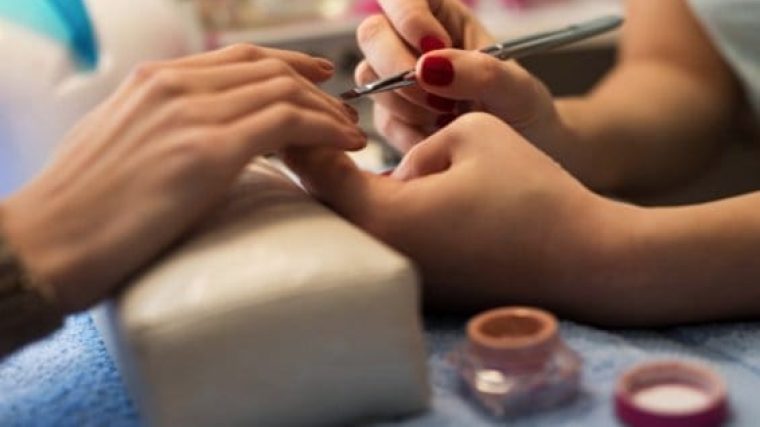
The nail technician practical exam is the hands-on part of the state board licensing test. You perform real nail services, usually on a mannequin hand, while examiners score your technique and your infection control. Many states require it along with the written exam, but not all of them do.
This guide covers what the national NIC practical includes, how Texas and Michigan handle it, what to pack, and the mistakes that cost candidates points. Every detail comes from official board and testing-vendor sources, which are linked throughout.
Who gives the practical exam, and how it differs from the written exam
Your state board decides whether you take a practical and which version you take. Most states use one of these:
- NIC National Nail Technology Practical. Written by the National-Interstate Council of State Boards of Cosmetology and used by many states. The current bulletin took effect September 1, 2025, and was revised March 1, 2026 (NIC practical bulletin).
- A state-specific exam given by a vendor. In Texas, PSI gives the TDLR manicurist exams (TDLR). Michigan uses the PSI National Manicurist test (Michigan PSI guide).
The written exam tests what you know. The practical tests what you can do. The NIC written (theory) exam has 110 multiple-choice questions, 100 of them scored, with 90 minutes to finish. Its largest topics are maintenance and removal of nail enhancements (20%), manicure and pedicure services (18%), infection control and safety (15%), and anatomy and physiology (15%) (NIC theory bulletin). The practical has no questions. Examiners watch you perform timed services and score each step.
Some states have no practical at all. California dropped it for every license type on January 1, 2022, so nail candidates there take only the written exam (California Board of Barbering and Cosmetology). Before you buy a kit, confirm your own state’s requirements.
NIC nail practical: section by section
The NIC practical has seven sections. Times below are as printed in the NIC bulletin.
| Section | Time |
|---|---|
| 1. Work area and client preparation, and set-up of supplies | 15 min |
| 2. Basic water manicure and polish application | 20 min (plus 5 min for polish removal and cleanup) |
| 3. Work area and new client preparation, and set-up of supplies | 10 min |
| 4. Full-well nail tip application and blending | 15 min |
| 5. Sculptured nail | 20 min |
| 6. Removal of sculptured nail | 20 min |
| 7. Blood exposure procedure | Examined individually (no time listed) |
The bulletin doesn’t give a total exam length. The listed times add up to about 105 minutes of timed work, not counting check-in, instructions, or Section 7.
Section 1: Set-up and client preparation
You set up your station and prepare the client. Infection control is scored the whole time. That means hand hygiene (soap and water, or hand sanitizer to simulate handwashing), gloves for each service, and cleaning and disinfecting tools and surfaces.
Section 2: Basic water manicure and polish
You do a basic water manicure on all five fingers. It must include at least one massage movement that covers the top of the hand, the palm, and all five fingers. Then you apply colored polish that can be clearly told apart from the nail plate. Next comes a separate 5-minute step: remove the polish and dispose of the supplies you used.
Section 3: New client set-up
You reset your work area and prepare for a “new client,” just as you would between appointments in a salon.
Section 4: Full-well tip application and blending
The proctor names one finger. You apply a full-well tip to it, then trim, shape, and blend.
Section 5: Sculptured nail
The proctor names one finger. You sculpt a nail that extends past the free edge, then shape, contour, and finish it. The product must be low-odor or less-odor, so check your state’s product rules too.
Section 6: Removal of sculptured nail
You remove the sculptured nail, then smooth and finish the natural nail. The bulletin doesn’t require a particular removal method. Acetone or polish remover and foil removal wraps appear only as suggested supplies.
Section 7: Blood exposure procedure
The scenario is a minor cut on the index finger. You take items out of your first aid kit, put on gloves, cover the cut with a secured absorbent dressing, and dispose of all contaminated supplies correctly.
Texas: TDLR manicurist practical (PSI)
The practical is still required in Texas. TDLR states that “You must pass written and practical licensing exams to obtain a Manicurist license,” after a 600-hour manicurist course. If you pass, you can start working that same day on a temporary license (TDLR manicurist license).
TDLR reported 7,031 Manicurist Practical exams in fiscal year 2025 with an 82.46% pass rate. The Manicure-Esthetician Practical had 253 exams and a 78.26% pass rate (TDLR FY2025 exam statistics).
The current sections, timing, and scoring are in the Cosmetology Manicurist Candidate Information Bulletin, which TDLR lists in English, Spanish, and Vietnamese on its exam page. Download it and follow it exactly.
Michigan: PSI National Manicurist practical
Michigan’s PSI guide (version 1.2, effective May 20, 2026) lists five timed areas, about 90 minutes in total (Michigan PSI guide):
- Workstation preparation: 10 min
- Basic manicure: 20 min
- Nail tip application: 20 min
- Nail enhancement using a form: 30 min
- Workstation preparation for next client: 10 min
You need at least 33 of 42 possible points to pass. Anything not finished within its time limit gets no score, and personal timers aren’t allowed. Mechanical or trainer hands with removable parts or digits are not permitted.
Nail practical kit checklist
This is the NIC bulletin’s suggested supply list (NIC). Kit rules vary by state and vendor. Michigan’s PSI guide, for example, says it has no supply list at all. Always check your own state’s candidate bulletin.
- Closable supply kit for dry storage
- Mannequin hand(s) with artificial nails attached, if your state requires them
- EPA-registered disinfectant wipes (bactericidal, fungicidal, virucidal) in the manufacturer’s container
- Hand sanitizer in the manufacturer’s container
- Gloves and a first aid kit
- Three disposal containers labeled “Items to be Disinfected,” “Soiled Linens,” and “Trash”
- Finger bowl with water, nail brush, cuticle softener, cuticle pusher, oil, massage product
- Nail files, buffers, nail clipper and/or tip trimmer
- Cotton, paper towels, towel(s)
- Base coat, visibly colored polish, top coat, acetone or polish remover
- Nail tips and adhesive
- Nail forms, sculptured nail brush, dappen dish(es), nail cleanser
- Monomer (low-odor or less-odor, factory sealed, original labeled container), polymer (original container), primer if used (original container)
- Foil removal wraps
The NIC bulletin also says you are responsible for anything else you need, even if it isn’t on the list.
Common reasons candidates lose points or fail
Bulletins don’t publish failure statistics by cause. They do spell out what leads to a failing score, lost points, or dismissal:
- Infection control lapses or an unsafe work area. Under NIC, this “may result in a failing score” and removal from the testing area.
- Mishandling the blood exposure procedure. This can get you dismissed (NIC).
- Wrong products or labels. NIC requires English labels and bans handwritten labels, labels that show order of use, and “single-use” labels. Disinfectant and sanitizer must be in original manufacturer containers, with no simulated products. Disinfectant and aerosol sprays are banned (NIC). Michigan bans all aerosols.
- Running out of time. In Michigan, unfinished work gets no score. Under NIC, everyone stops when the timer goes off.
- Kit discipline. Under NIC, the kit stays closed except when you take something out, and nothing goes back into it.
- Prohibited items or conduct. Phones, watches, notes, or talking with other candidates lead to dismissal (NIC).
- A mannequin that doesn’t qualify. NIC requires a whole hand with no removable digits, approved by the state or vendor before you’re admitted.
All points above come from the NIC bulletin and the Michigan PSI guide.
FAQ
Do I need a live model for the nail practical exam?
It depends on your state. The NIC bulletin points you to state-specific guidelines for model and mannequin requirements. If a mannequin hand is required, it must be a whole hand with no removable digits, and the state or vendor must approve it (NIC).
What score do I need to pass?
It varies. Michigan’s PSI practical requires 33 of 42 points (Michigan PSI). The current NIC practical bulletin doesn’t state a passing score. Virginia’s 2022 NIC bulletin listed 75 as the minimum for both theory and practical (Virginia DPOR, 2022). Confirm the current figure with your own state.
Do I take the written exam first?
Your state sets the order and the scheduling rules. Check your board’s exam page and your candidate bulletin.
Does every state require a nail practical?
No. California, for example, has required only the written exam since January 1, 2022 (California BBC).
Prepare for the written exam too
Try our free nail tech practice test, or study with the full Nail Technician study package.
