

A strong hairstylist portfolio shows salon owners and potential clients what you can do before they meet you. It brings your strongest haircuts, color work, styling techniques, transformations, qualifications, and professional information together in one place.
This guide explains how to create a hairstylist portfolio from start to finish, including what to include, how to photograph your work, which format to use, and how to build a professional portfolio when you have limited salon experience.
Use the steps and checklist below to begin selecting and organizing your best work.
Quick Answer: What Should a Hair Stylist’s Portfolio Include?A professional hairstylist portfolio should contain approximately 10–20 high-quality examples of your best work, organized by service or specialty. It should also include before-and-after photos, brief captions, a professional bio, qualifications, contact details, and a link to your resume, social profile, or booking page. |
What is a Hairstylist Portfolio?
A hairstylist portfolio is a curated collection of work that demonstrates your technical skills, creativity, specialties, and professional development. It works as a visual resume for salon employers and as proof of results for potential clients.
A portfolio may be presented as a website, social media gallery, shareable PDF, digital presentation, or printed book. Regardless of the format, it should make your strongest and most relevant work easy to evaluate.
Why Hair Stylists Need a Professional Portfolio
A resume can describe your education and experience, but it cannot fully demonstrate the quality of a haircut, the blending of a color service, the finish of an updo, or your ability to work with different hair textures.
A professional portfolio helps salon owners evaluate your technical range, consistency, attention to detail, and suitability for their clientele. For independent stylists, it gives potential clients visual evidence of the services and results they can expect.
Your portfolio can also help you:
- Prepare for salon interviews.
- Apply for apprenticeships or assistant positions.
- Attract clients through search and social media.
- Establish a recognizable specialty.
- Track how your work improves over time.
- Support applications for events, competitions, or editorial projects.
Decide Who Your Portfolio Is For
Before selecting your work, decide what you want the portfolio to achieve. A salon hiring manager and a prospective client may look for different information.
|
Portfolio goal |
What to emphasize |
|
Applying for a salon job |
Technical range, training, licensing, consistency, professionalism, resume, and relevant salon experience |
|
Applying to a specialist salon |
Work that matches the salon’s services, clientele and visual style |
|
Attracting new clients |
Specialties, transformations, reviews, location, service information, and booking options |
|
Building a freelance or editorial career |
Creative concepts, collaborations, credits, publications, and behind-the-scenes work |
|
Documenting student progress |
School assignments, mannequin work, supervised client services, and developing techniques |
You can maintain one complete collection of your work while creating shorter, tailored versions for different applications.
What Should You Include in a Hairstylist Portfolio?
A hairstylist portfolio should provide enough information to understand your skills without distracting from your work.
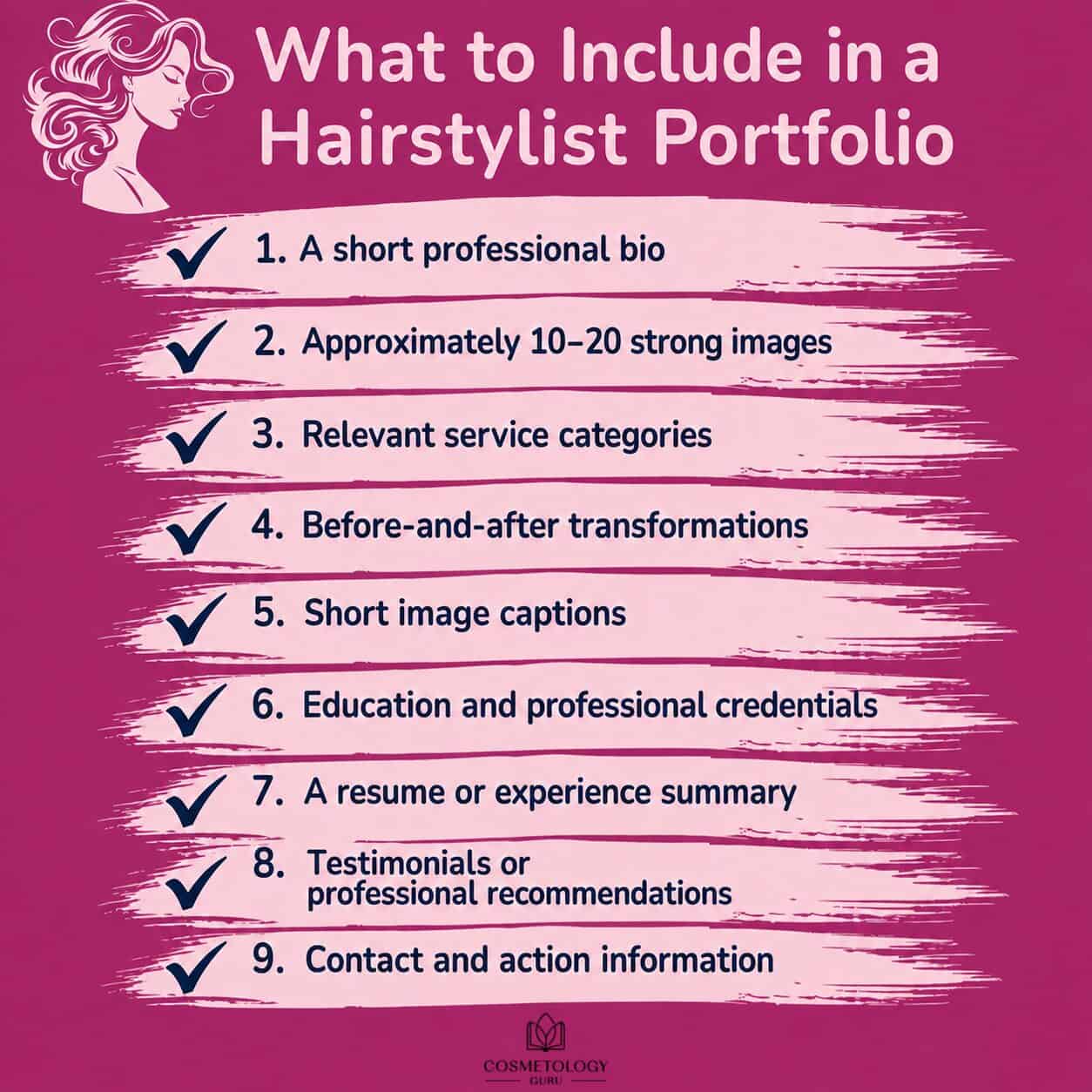
It also removes the contradiction between showing every skill and keeping the portfolio selective.
How to Make a Hair Stylist Portfolio Step by Step
Step 1: Define your goal
Decide whether the portfolio will be used for salon applications, client acquisition, freelance work, competitions, or school assessment.
Step 2: Choose a portfolio format
Select a website, social media gallery, PDF, printed book, or combination based on how the portfolio will be shared.
Step 3: Collect your available work
Gather photographs from school assignments, salon services, mannequins, models, events, competitions, and personal projects.
Step 4: Confirm permission
Make sure you have permission before publishing identifiable photographs of clients, classmates, or models. Follow relevant salon policies and local requirements.
Step 5: Evaluate image quality
Remove blurry, poorly lit, heavily filtered, repetitive, or unfinished examples.
Step 6: Select the most relevant work
Choose approximately 10–20 images that demonstrate your strongest and most useful skills.
Step 7: Write your portfolio information
Prepare your bio, captions, qualifications, specialties, contact details, and resume.
Step 8: Organize the work
Group images by service, skill, or specialty so viewers can quickly find relevant examples.
Step 9: Review the complete portfolio
Check image quality, spelling, mobile usability, links, contact information, loading speed, and overall consistency.
Step 10: Tailor and share it
Create a shorter version for each salon application or use a client-focused version containing booking information, reviews, and services.
When Should You Start a Hairstylist Portfolio?
Start building your portfolio as soon as you begin producing work you are proud to show. Cosmetology students can document mannequin assignments, supervised student-salon services, class projects, model work, and competitions.
Beginning early helps you improve your photography and recognize which techniques require more practice. As you gain professional experience, gradually replace student work with stronger salon examples.
It is never too late to begin. Working stylists can start by reviewing recent client photographs, arranging model sessions, and documenting future services more consistently.
Preparing for your licensing exam? Use the free cosmetology practice test to identify the subjects you need to review before exam day.
How to Take Photos for a Hairstylist Portfolio?
Strong portfolio photography should represent your work accurately. A modern smartphone can produce professional-looking images when the lighting, background, positioning, and focus are controlled.
Use consistent lighting
Photograph your work in bright, even lighting. Natural indirect light usually produces more accurate results than harsh overhead lights, but a ring light or adjustable salon light can help maintain consistency.
Avoid mixing several different light sources because they can alter the appearance of hair color.
Choose a clean background
Use an uncluttered wall, backdrop, or salon area that contrasts with the hair. Remove products, cords, chairs, people, and other distractions from the frame.
Capture multiple useful angles
Take photographs from the:
- Front.
- Left and right sides.
- Back.
- Three-quarter view.
- Close-up detail view.
Different angles help viewers assess shape, blending, texture, color placement, and finishing.
Match before-and-after photographs
Use the same camera distance, angle, lighting, background, and client position for both photographs. Consistency makes the transformation easier to evaluate.
Show the true color and texture
Avoid filters or editing that significantly changes the hair’s shade, shine, density, or texture. Basic cropping, exposure correction, and background cleanup may improve presentation, but the result should remain accurate.
Prepare the complete presentation
Check the hairline, parting, flyaways, finish, and overall shape before taking the photograph. Clothing and accessories should complement the result without competing with the hairstyle.
Keep the image sharp
Clean the camera lens, tap to focus on the hair, keep the phone steady, and take several versions. Review the photographs at full size before the client or model leaves.
Consider professional photography selectively
A professional photographer can be useful for competition, editorial, bridal, or signature work. However, a photographer is not essential for every portfolio image when you can produce consistent, accurate photographs yourself.
How to Find Models for a Hairstylist Portfolio?
You do not need an established client list to begin building a portfolio. Potential sources of portfolio work include:
Friends and family
Offer a clearly defined service in exchange for permission to photograph and publish the finished work.
Cosmetology classmates and student-salon clients
Document services are completed under supervision, provided your school and client allow the images to be used.
Social media model calls
Post the exact service, date, approximate duration, eligibility requirements, cost, and intended use of the photographs.
Creative collaborations
Work with photography, makeup, fashion, or modeling students who also need portfolio material. Agree in advance on credits and image-use rights.
Community events and competitions
Volunteer work, fashion events, bridal demonstrations, and cosmetology competitions can provide distinctive examples when photography is permitted.
Mannequin work
Students can include high-quality mannequin work when it demonstrates a relevant technique. Label it clearly and gradually replace it as stronger client or model work becomes available.
Always obtain permission before publishing recognizable images and follow the relevant policies of your school, salon, event, or workplace.
How to Build a Hair Portfolio Without Professional Clients
A beginner’s portfolio does not need to consist entirely of paid salon work. Employers understand that students and newly licensed stylists are still developing their experience.
You can include:
- Clearly labeled mannequin work.
- Cosmetology school assignments.
- Supervised student-salon services.
- Friends and family models.
- Volunteer styling.
- Competition entries.
- Technique demonstrations.
- Personal creative projects.
Focus on clean execution and professional presentation. Explain what you completed, the technique you used, and what you learned from the service.
As your experience grows, replace early examples with more advanced work rather than continually adding to the portfolio.

Which Hair Stylist Portfolio Format Should You Use?
The best format depends on how you plan to share the portfolio. Many stylists use one main digital portfolio and create a PDF or printed version only when an employer requests it.
|
Format |
Best use |
Main advantage |
Limitation |
|
Portfolio website |
Personal branding and attracting clients |
Complete control over organization, search visibility, and booking links |
Requires setup and maintenance |
|
Instagram or another visual platform |
Discovery and frequent updates |
Easy to publish and share |
Work can be difficult to organize and depends on the platform |
|
PDF portfolio |
Salon applications and email sharing |
Easy to tailor for each opportunity |
Must be manually updated |
|
Cloud-based gallery |
Quick, inexpensive sharing |
Simple to create |
Usually less polished |
|
Printed portfolio |
In-person interviews or practical assessments |
Does not depend on internet access |
Costs more and becomes outdated quickly |
How to organize the portfolio
Arrange the content in a logical order:
- Cover or portfolio homepage.
- Professional bio and specialties.
- Strongest or most relevant work.
- Service categories.
- Before-and-after transformations.
- Testimonials or achievements.
- Qualifications and resume.
- Contact or booking information.
Use a clean layout, readable text, large images, and consistent spacing. Avoid decorative fonts, busy backgrounds, excessive animations, or design elements that compete with the hairstyles.
Test every digital version on a mobile phone. Employers and clients should be able to open the portfolio quickly, move between categories, and find contact information without searching.
How to Write Captions for Hairstylist Portfolio Photos
A portfolio caption should explain what the viewer cannot learn from the photograph alone. Keep it to one or two sentences and include the most relevant details.
A useful caption can identify:
- The service is completed.
- The starting hair condition.
- The technique used.
- A technical challenge.
- The intended result.
- The part of the work you completed.
Example caption
Dimensional brunette balayage completed on previously colored, medium-density hair using a blended-root technique for softer regrowth and lower-maintenance results.
For collaborative projects, clearly credit the photographer, makeup artist, model, salon, or other contributors.
Common Hair Stylist Portfolio Mistakes
Including too many similar photographs
Five examples of nearly identical work do not demonstrate range. Select the strongest image unless each example proves a different skill.
Using heavy filters
Filters that alter color or texture can make viewers question the accuracy of the result.
Showing inconsistent before-and-after images
Different lighting, angles, or styling can make transformations difficult to evaluate.
Leaving images unexplained
Add short captions when the technique, challenge, or result is not immediately clear.
Using outdated or weaker work
A large portfolio is not necessarily a strong portfolio. Remove examples that no longer represent your ability.
Forgetting contact information
Make sure salon managers and potential clients can immediately identify how to contact, follow, or book you.
Using broken or restricted links
Test portfolio, resume, social media, and booking links before every application.
Sending the same portfolio everywhere
Tailor the first and most prominent examples to the salon, role, specialty, or client group you want to attract.
How to Keep Your Hairstylist Portfolio Updated
Save strong work continuously rather than waiting until you need to apply for a job. Conduct a complete portfolio review every three to six months or whenever your services, specialty, experience, or career goal changes.
During each review:
- Replace weaker work with stronger examples.
- Remove outdated trends unless they demonstrate an important technique.
- Update your bio, qualifications, location, and specialties.
- Check your contact information and links.
- Confirm that your portfolio loads correctly on mobile devices.
- Add recent work that reflects the clients or salons you want.
- Replace student work as professional examples become available.
- Remove services you no longer want to promote.
A focused portfolio containing current, relevant work is more effective than a large archive of everything you have completed.

Start Building Your Hair Stylist Portfolio
Begin by deciding whether your portfolio is intended for salon employers, prospective clients, or another professional opportunity. Then select approximately 10–20 examples that best support that goal.
You do not need a complex website or professional photography session to begin. A clear, accurate, well-organized portfolio containing strong work, useful captions, qualifications, and current contact information can provide employers and clients with the evidence they need to take the next step.
Review the checklist before sharing your portfolio, and continue replacing older examples as your skills and experience develop.
FAQs about Hairstylist Portfolio
1. WHAT SHOULD I NOT INCLUDE IN MY PORTFOLIO?
Avoid including poor-quality images, outdated hairstyles, or styles that don’t showcase your best work. Don’t add irrelevant information like personal hobbies or unrelated work experience. Keep your portfolio focused on your strongest hair styling skills and achievements.
2. HOW DO I MAKE MY PORTFOLIO STAND OUT?
To make your portfolio stand out:
- Showcase a diverse range of hairstyles and techniques
- Use high-quality images
- Include before and after photos to highlight your transformative skills
- Organize your portfolio in a clean, visually appealing layout
- Add a personal touch, such as a brief bio or mission statement, to reflect your unique style and passion
3. HOW LONG SHOULD A STYLING PORTFOLIO BE?
A hairstyling portfolio should be concise yet complete. Aim for 10-20 high-caliber images that showcase your range and talent. Prioritize quality over quantity, and choose images that best represent your skills and creativity. The goal is to provide a clear snapshot of your abilities without overwhelming the viewer.
4. WHAT IS A BEAUTY PORTFOLIO?
A beauty portfolio is a curated collection of a beauty professional’s work, showcasing their skills, creativity, and expertise in areas like makeup, hairstyling, skincare, and nail art. It serves as a visual resume to demonstrate a range of techniques and styles, helping to attract clients and secure job opportunities.
5. WHAT SHOULD A GOOD PORTFOLIO LOOK LIKE?
A good portfolio should be clean, organized, and visually appealing, showcasing a variety of skills and styles with high-quality images. Include before-and-after shots and diverse looks to highlight versatility. Keep the layout simple and professional for easy navigation and update it regularly.
6. SHOULD YOU PUT YOUR FACE ON YOUR PORTFOLIO?
No, it’s not necessary to include your face in your portfolio. Focus on showcasing your work and skills through high-quality images of your hairstyling or beauty creations. However, adding a professional headshot in an “About Me” section can help personalize your portfolio and make it more relatable.
Related read: What are cosmetology working conditions like?
Related read: Can a cosmetologist become a barber?
Related read: What is a cosmetologist’s typical work schedule?
